art review, march 1986
Thomas Newbolt
Browse and Darby
Thomas Newbolt graduated from Camberwell in 1974 with first class honours, went on to win Italian and French Government Scholarships, spent two years (courtesy of a Harkness Fellowship) at the University of Virginia and the following year, 1883, as visiting artist at the University of Wisconsin. In between times he has been teaching in this country . This is his first one man show in London and one wonders why, for this selection of oils and charcoal drawings is a cogent display of expressive power.
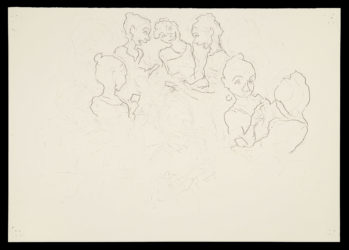
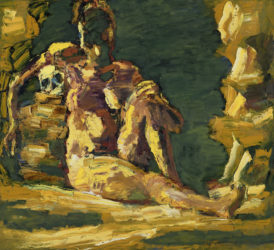
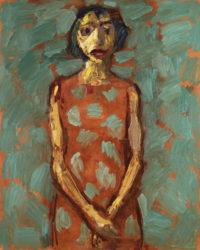
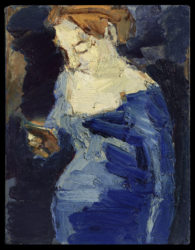
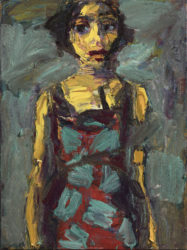
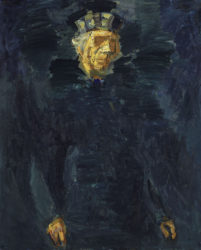
A series of four heads and two nudes make an excellent lead into his work. Save for the fourth the heads are largely featureless, bold planes of thick colour streaked with violet and daubed with orange and purple with a suggestion of suffering Rouault. From here to the nudes it is a quick step to noting that they too have blank empty faces. Virtually lifesize, both are treated in bold gestural colour, crimson greeny-blue and red highlights on yellow given emphasis by matt and shiny blacks. Half turned, breast upthrust, ample buttocks harlequin-daubed, the second figure strikes a burlesque pose taking us to the heart of the exhibition - the carnival of the comedie humaine.
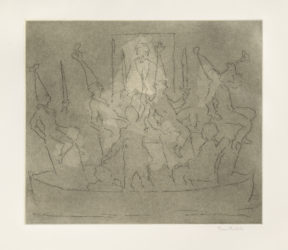
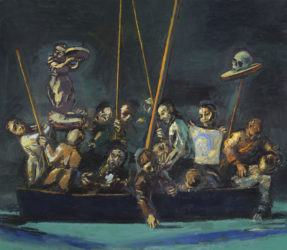
Twin themes of carnival and the ship of fools fill the gallery with movement and colour, with recurring images of fun fair horses, masks, musicians and jesters, all gaudy razzmatazz of the fair. The large charcoal Carousel, with its roundabout horses, sweeps you off your feet with its beauty, but when Newbolt introduces his dramatis personae one suspects the carnival is an antidote to despair. Lantern-jawed, Burra-esque revellers seem to seek oblivion in the bottle and the crowd. For all its brilliant carnival colour the large oil Mardi Gras screams with tension: there is no knowing how the night will end. The amazing charcoal Ship of Fools (58" x 84") complete with horse, confirms our suspicions. A ribald crew amuse themselves by throwing a baby in the air while at the other end of the boat the so-called fools and jesters see the world more clearly. One weeps behind wide fingers.
With two charcoal drawings of mother and child a more optimistic note is struck. The portraits are not totally realized but drawn with an incisive vigour that focuses most movingly on the mother's strength and protective tenderness. Finally, to correct any negative impression I may have given I should say I left the show with a sense of exhilaration at this brush with raw humanity. (to Mar 17)
Jane Norrie.
the spectator, march 1986
Exhibitions - Thomas Newbolt
(Browse and Darby till 27 March)
In the past year the promoters of Browse and Darby (19 Cork Street, W1) have shown admirable enterprise in giving one man shows to artists who are not widely known as yet. Christopher Stein was one such mature artist and now Thomas Newbolt represents a younger generation. I suspect, with the catalogue divulging such useful information, that Newbolt may have been taught by Stein at Camberwell School of Art. The artists share an emphatic kind of mark-making where the brush stroke is customarily left square-ended, wherever it finishes. In Stein's little paintings and Newbolt's small-size works the device is not especially intrusive. But in large canvases, especially where black outlines are used, the mannerism - mannerism because the use it not strictly descriptive - becomes increasingly repetitive. The introduction of lighter and less assertive marks would lead to better orchestrated paintings and perhaps a reduction in dentist's bills that could result, in future, from too much clenching of the teeth. These add up to only minor criticisms of an interesting and promising show. Newbolt's paintings owe apparent debts to Sickert and Rouault as well as Bomberg and Auerbach. His drawings, on the other hand, are clearer and so seem more directly personal in style. Their subject matter would be hard to fault.
Giles Auty.
the daily telegraph, art, march 1986
Thomas Newbolt's exhibition at Browse and Darby (19 Cork Street, W1, until March 27) makes it seem surprising that this is his first London one-man show. Newbolt is an artist of originality and arresting technical accomplishment.
He is 35, was trained at Camberwell School of Art and it is indicative that he received recommendation in art history. Soon after leaving Camberwell, Newbolt was awarded an Italian government scholarship and another, this time from the French government, followed. Since then he has been Harkness International Fellow at the University of Virginia and visiting artist at the University of Wisconsin-Milwaukee.
Above all, Newbolt is a craftsman of an unusual kind: in the upstairs gallery at Browse and Darby there are three very large charcoal drawings by him, one of them measuring 5ft 5 1/2 inches by 6ft 10inches, which, because of their size, technique and assurance, recall Renaissance cartoons.
There is also a compulsive strangeness about these big drawings. In one of them, three madly galloping horses charge at us, while another is on the theme of Mardi Gras in New Orleans and the third is entitled "Ship of Fools." Again, we are reminded of the past. The artist is in the New Orleans drawing and in "Ship of Fools" concerned with the expression of deep-seated human emotions and mood. Pathos and the abandonment of carnival mingle.
In the downstairs gallery, there are paintings suggesting some of the sources of Newbolt's art. There are reminders of Max Beckmann and Rouault and also Ensor.
Newbolt is a thinking artist, concerned with the human situation. It is unusual, in the context of today, that he has found technical means of expressing what he has to say and these means are at once bold and commanding. This may be the time of year to recall Mardi Gras but these drawings and paintings have a wider reference.
Terence Mullaly.
browse and darby, press release, october 1988
Browse and Darby
19 Cork Street, London W1X 2LP
Telephone : 071-734 7984
Fax : 071-437 0750
PRESS RELEASE :
THOMAS NEWBOLT - New York: 30th October - 23 November 1988
Thomas Newbolt (born 1951) is a figurative painter of haunting expressiveness. He interprets the human condition for us with imaginative sympathy, but he is equally capable of satirising the follies of mankind in powerful charcoal studies of Goyaesque savagery. Here is an artists richly and fruitfully steeped in the art of the past, unafraid to acknowledge debts, whether through direct copies of the masters - Cezanne, Rembrandt - or in allusions to Rouault, Delacroix and Beckmann. The complexity of Newbolt's compositions is as much a matter of meaning as design. What goes on? Menace or melancholy? The subject remains essentially mysterious; only atmosphere is suggested. The allegory, if such it is, rests obscure.
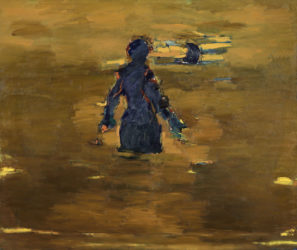
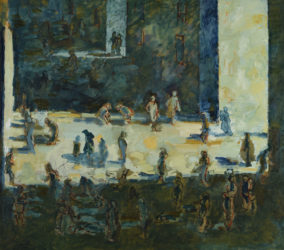
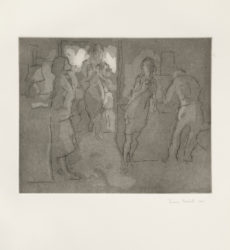
Newbolt tends to paint in series, seizing upon a theme and exploring it relentlessly, in order to extract the last ounce of pictorial information and human truth from it. The single figure or the crowd are favoured motifs. Sometimes an air of carnival pervades the scene. Carousel or Mardi Gras, ship of fools, a confrontation on a bridge, fen skaters. Dramatic tonal play is counterpointed by sombre yet vivid colour (indigo and cream, orange and black, startling blues and lemons), while Newbolt's distinctive broad brushstrokes create further visual excitement. As Modern Painters pointed out after his last exhibition, 'Newbolt's talents are major talents'.
modern painters, summer 1989
Thomas Newbolt
by Martin Golding
At the beginnings of modern art, Van Gogh rephrased once more the central problem of representation: 'What is drawing? How does one do it? It's the action for forcing one's way through an invisible iron wall which seems to be located somewhere between what one feels and what one can do'. The 'iron wall' suggests a metaphor for the difficulty of moving through the picture-plane into pictorial space, and back. But more essentially, Van Gogh conflates technical difficulty with that of expressing emotion: to realise form is at the same time to realise the painter's own feeling before the subject. These two sides, in the practice of some esteemed younger contemporaries, are often separated - handy quasi-expressionist textures on the one hand, and on the other quasi-exact registrations whose impact depends on the decoding of complex surrealist allusions. It has been found easy to praise the impression of emotional involvement given in the one, or the skilful deployment of spaces and puns in the other, without asking the one necessary critical question: what does either amount to? More specifically - does this energy speak as form; or, does this adroitness move us?
In the work of Thomas Newbolt we find no such separation. His paintings stand out, at once in their engagement with the major tasks of realisation and in their direct and intransigent expression of feeling. He achieves this, first, by a serious grappling with the central problem of pictorial space as it issues in both its ancient and modern constructions: the classical relation of figure and ground, and the play between the picture-plane and three-dimensional space. And secondly, his paintings explore repeatedly a few major themes, some of which have been with him, in different forms, for many years, and have developed a concentrated and intense life. Last year he exhibited his paintings at Tatischeff in New York, and etchings and paintings (in two separate shows) at Browse and Darby in London. At Tatischeff the large canvases were all on the theme of the
Crowd Scene, The
Bridge and
Ship of Fools - subjects which had also dominated his etchings. At Browse and Darby he also exhibited, among others, large
Bridge and
Ship of Fools paintings. Both galleries are showing his work this year at the Chicago Art Fair. The scenes, whatever their subject, present themselves dramatically: they are complex and vivid in tone and colour, and convey an atmosphere often of melancholy, or obscure menace. Crowds populate a plan in purple-indigo night, gathered round a knot of struggling figures; small groups of anonymous figures strain threateningly towards each other on a foot-bridge over water which reflects an orange-yellow evening sky; a boat containing a strange variety of passengers, engaged in mysterious rituals, drifts in an empty sea. Though the images create and explore an often far-reaching space, they also present a complex surface articulation of colour, which builds up a subdued dense pattern of colour-values. There is an exchange, and also a tension, between three-dimensional qualities and the surface of the picture. The figures combine a rounded, monumental character with, in some works, a variegated life of human particulars.
The subjects are mysterious. These are not 'narrative' or 'illustrative' paintings: their power issues from the conviction with which their forms exist in the spaces they create round themselves - how our sense of the speaking character of the human figure is addressed and moved. One is aware too, of a tradition of representation drawn on as an underlying, intermittently surfacing vocabulary. The human images of Rembrandt, Goya, Delacroix, Daumier, Beckmann - 'graphic types' (in Philip Rawson's words) 'which give the world its meaning' - are taken up and transformed in the furtherance of the painter's task - 'an act of praise or celebration of the world which is an image of oneself'. The
Ship of Fools, dominating both at Tatischeff and Browse and Darby, is a visual trope of this kind. The shell of the boat contains, in the six pictures, respectively, a Flagellation, figures raising sticks, stretcher bearers, Flaying of Marsyas, a group tossing a baby in a blanket, an assorted crew of mad, insouciant or despairing wretches accompanied by musicians who might have strayed from the orchestra at Auschwitz. Behind these images is the tradition of
Knarrenschiff and powerfully, the vessels of Bosch, of Gericault, of Delacroix. But there is, on the canvas, no suggestion of a history, or a destination. Nothing brings these figures together, or explains their absurdity, indifference, or intent malignity - despite the many echoes - but the visible boat itself. It creates an atmosphere which expresses madness, human impulses turned against themselves or outwards in obsessive and meaningless rituals of violence. The visual juxtaposition and confinement at once intensifies the presence of the human figures, and charges the scene with threat and disequilibrium.
The effect of these images is immediate, and, despite their enigmatic character, they require no interpretive gloss. They are charged with feeling, but not with symbols: we accept them as we find them. But this is so because they are immediately present as paintings - '
in una sola occhiata': the figures in the boat are bound together by the response of painted surfaces to each other. The classical effect, in which figure and ground combine so that the work's whole range offers an instantaneous pattern of form and colour, is essential to the
emotional tenor of the paintings. The shape of the boat brings together, creates, and is itself the subject. Imaginative space is conceived and realised as an actual space: the gestures of the facture are the bearers of and are themselves expressions of the painter's emotion. The emotional excitement is made possible by and lives in a
visual excitement - the outcome of Newbolt's ability to bring together figures and ground in one panorama in which the forms keep their integrity and exist in a recognisable space between and beyond them.
The way in which this is achieved is, however, often rough-and-ready: the figures are, close-up, sometimes unclear as representations, but become articulated when stood back from. They and their spatial relations are formed, not by the use of line, but in a complex texture of colour, with a palette which over the last few years has markedly extended its range. His line varies: in some recent paintings it sometimes disappears completely - as in
Ship of Fools - Flaying of Marsyas, where the figures are made up of jagged incremental brush marks. The stepped outline of the figures seems to shake with a violence which reflects and communicates the savagery of the scene. Concomitantly, figure and ground jostle: there are places (again most marked in
Flaying of Marsyas) where the ground seems as protuberant as the figures which populate it. Thus, the revelation of the figures among themselves is not achieved through an illusionistic space, but through the solid materials of the pigment, creating and deploying the light across the picture-plane.
The Ship of Fools subject concentrates, sharpens, parodies, allegorizes. The movement between the surface and the realised subject is continual, and powerfully expressive. The imaginative power of the image extends beyond the visual facts, but is also implicit in the decision behind each brushstroke. There is an intransigence about Newbolt's procedures from which this concentration derives: a determination to make the figures speak visually, but also always 'to leave the painting open' - giving the spectator the sense of potential movement and change. This accounts for the sometimes ragged forms, which seem to be in continuing dynamic exchange with their dividing spaces, never complete The images lack the 'finish' of some of those of Newbolt's contemporaries, but they thereby gain in emotional power. They show a world of intent separate reality, which, by its visual coherence, constitutes an objective world of human emotions - of struggle, blindness and chance. But they also, as Newbolt intends, give the anonymous figures the universality of myth. Their strangeness reverberates; it both expresses and seems to stand as metaphor for the task of making three dimensions in two - conveying how world of madness is yet a real and tangible world, how a flat picture-plane can create a world of space, and can penetrate the 'invisible iron wall'.
Very few of Newbolt's contemporaries approach this ancient problem of realization with such intelligence, or with a comparable feeling both for the continuities of the task of painting and for the need to take the risks he does. Fewer still match the amplitude of his imaginative ambitions. His works need not fear the necessary question - 'What does it amount to?'. Newbolt's talents are major talents. Some of these big canvases look to me like major paintings.
julian bell, private view catalogue, 1997
Foreward
Shut up in their studios, painters try to make the materials of their craft speak to them. They coax or bully paint, pleading it to shout or sing. There needs to be some sort of miracle; there has to be, somehow, more coming back from the canvas than the painter has consciously put in. If not, there would be no call to continue practising this peculiar and laborious way of producing images.
In one such solitary box - a weatherboarded shed off an East Anglian village street - the pleading is pursued with an uncommon intensity and weight of knowledge. Thomas Newbolt paints with the masters - old and modern - on his back. It's a burden that's potentially disabling. He has looked long and searchingly at the miracles elicited by Chardin and Cezanne and at the monumental compositions of history painting. Turning his eyes away from that glut of mastery, he confronts the canvas with a sense of responsibility that borders on desperation. How, in turn, to make marks that carry a comparible charge?
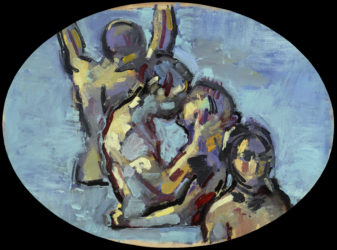
Newbolt's strategy has always centered around human figures - bodies that would bear some of the weight of feeling with which he has invested his art. In his painting through the 1980s and earlier 1990s, he imagined complex knots of action - ships of fools, skaters on ponds, scenes of mythic tragedy - in which the tug of figures seemed to echo the tensions of the tradition behind him and of his own predicament in relation to it. These compositions culminated in the awesome Medea, worked to a point where the whole field of paint at once shimmers and aches.
More recently, his focus has narrowed and intensified. The newer paintings are less dependent on classical ideas of composition; they rely rather on their overall qualities of marking. One painting in particular from the tradition has been the stimulus behind much of the work shown here: Rubens' Death of Hippolytus in the Fitzwilliam in Cambridge, a heroic figure thrown to his death by rearing horses. The manically energised horses here develop, as Newbolt obsessively reworks them, into a prompt for every kind of transcending passion, every Baroque impulse, that might leap out from the flat of the picture.
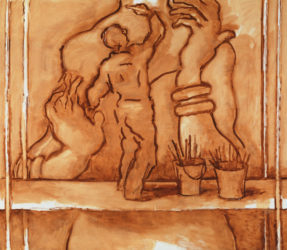
The other main stimulus in this body of work has been a return to working directly from life. The naked person facing him across the studio challenges Newbolt to answer with a matching nakedness in his marking. The colour he sets down aims to be entirely of her - a personal response to her presence, her strength and vulnerability. At the same time, he wants to affirm it as entirely oil and pigment., declare it as fatty material streaking a flat surface in which all marks have an equal palpability.
It's a strenuous agenda, though one familiar to all painters working in the wake of Cezanne. A forceful agenda, however, is no guarantee of results. What saves Newbolt is his sure instinct and well-informed passion. Trapped in his box of desperate intent, he performs with extravagant flair. His gestures are nimble and surprising, his colours go for the jugular. Enacted with this depth of knowledge and this persistency, a search for meaning and emotional charge in painting that might be arid becomes its own rich reward, producing work that restates the vitality of the art with new charge.
'Lord, I cried to you all night,' says the supplicant Rumi's parable: 'Why did you give me no sign of your presence?' 'Your crying', the Lord Answered, 'was my drawing you towards me; your pleading is itself my presence.'
Julian Bell.
martin gayford, private view catalogue, august 2000
Introduction
Thomas Newbolt is a unique figure in contemporary painting (which itself is composed largely of isolated figures). His work looks, and is, the product of a romantic imagination. But it is an imagination which is fed by voracious, eclectic, long meditated reading - and by equally wide-ranging browsing through the visual library of art, past and present (plus, of course, his own experiences). In his work, one image tends to grow into another in a dreamy, associative fashion.
His sources would in many cases defy the most assiduous art-historical detective. The stag, for example, is a motif that became fixed in his mind through reading a story by Faulkner, which intertwined with another by Flaubert. But in the process of gestation that stag became the creature once allegedly encountered in the forest by St. Eustace. And that forest itself grew from, among other memories, some Californian redwoods and South German trees. (Some of Newbolt's trees verge, as his art often does, on the abstract). The image of the cave came, from the contrary, visual direction - its origin is in Mantegna's Christ Descending into Limbo. But it too becomes almost abstract in a painting such as Cave 1999.
In the paintings you can discern some of his heroes - Goya, for example, and Daumier - but the training he received from, among others, Euan Uglow and Chris Chamberlain, is apparent in the firm geometric scaffolding that holds every picture firmly, and beautifully, together.
urthona magazine, issue 15, 2001
Thomas Newbolt, who was born in 1951 and studied at Camberwell school of art, has been painting, exhibiting (in Britain and the USA) and teaching for many years. Having known him for few years through classes and exhibitions I went along went along with interest to two recent exhibitions, one of small paintings, monotypes and etchings at the Broughton House gallery, Cambridge and some larger paintings at the Grosvenor gallery, London.
As you enter the London exhibition there are two big pictures of stags being hunted by a rider on horseback, complementing each other like mirror images; the stag in one to the left and the other to the right. The first impression is colourful, festive, celebratory. In each an indistinct rider aims his arrow at a stag, the arrow itself being emphasized so at first site could be a gun. Orange-yellow lines dart and flash on a deep red background: the suggestion of lit branches in a wood, and of movement. The stag stands erect, a noble calm presence in a world of flurry. Above his head is a crucifix. Dogs tear around the base of the picture towards him. Little figures like putti fly in the sky above the stag, as if celebrating him. The wood has a magical feel coming from the strong contrasts of light and dark and the unrealistic colour. The stag is striking in its dignity before you even know the story: the vision of St. Eustace. St. Eustace was out hunting when met a white stag with a radiant crucifix between its antlers. He was converted. At the same time he heard a voice of warning he would have many tribulations as his test of faith.
Although the paintings may come from a story such as this, as well as from other associations in the artist's mind- in this case for example stories of stags by Faulkner and Flaubert or his own memories of taking his dogs for walks in the early mornings, and the quality of light at that time- the paintings are deliberately named simple 'stag' 'cave' 'horses' and so on, to allow for as wide an interpretation as possible. This they are not illustrations but depictions of a scene which takes on an archetypal, mythical significance. This is so too because of the believable (based on observation) yet unspecified way that the space and figures are treated- a bare piece of ground, a hardly distinguishable figure- because the point of the picture is in the drama and feeling evoked by the way it is painted.
The beauty and power of Thomas Newbolt's work comes from different (and connected) levels. Partly it is this sense of a dramatic moment, of something profound that is happening and what does that evoke in us? Partly it is the surface, the enjoyment of paint on canvas and the juxtaposition of colour. The colours are rich and varied although held together by some overall predominating palette, for example alizarin crimson, Prussian blue and pale lemon yellow. The paint marks are evident, maybe thick and dry and come forward or more fluid and merged with under layers. All applied with energy and passion and drama in keeping with the subject, an excitement in the process of painting and a freshness from the apparent speed with which some marks are applied, in a frenzied swirl, for example. I'm thinking here particularly of some of the 'cave' paintings where the paint marks are half describing the landscape but seem more to become abstract marks, equivalents of the feelings of the characters involved, as well as beautiful in their own right. Another aspect is the formal beauty of the compositions, the relationship between his surface and the depth of space in the painting. I enjoyed the ambiguities in the space sometimes, for example in the first stage picture where the dogs being dark look initially like background shadow, but are then seen by their shape to be in front.
The first of the 'cave' pictures I saw was in the Broughton House gallery show. A shape- human probably but what exactly- a traveller with a load? A couple embracing? standing dark against a brilliantly lit pale yellow background while above was a dark mass of swirls of colour including dusky purples and above a striking vermillion sky laid on in horizontal marks, suggesting sunset/rise. A sense of revelation came from the brilliant light of the cave and then there was the suggestion of an emotional journey through dark night to a sense of consummation and peace. It was only afterwards that I discovered Thomas had in mind the story of the Descent into Limbo; according to this Christ descended into hell after his crucifiction to rescue the dead who were there. This myth has parallels with heroes in classical mythology who descended to the underworld to rescue the dead (Orpheus, Hercules) and in the Buddhist tradition with Ksitigarba. What might it mean to us personally- could It be about bringing our darkside into light, integration? but that seemed too psychological and reductive. About compassion? relief at the end of suffering? catharsis? death and rebirth?
It was interesting that the London 'cave' pictures treated the same theme but had a different emotional feel. For a start the figure was small, touched by light, against a dark cave which it looked about to enter. In one picture it looked like a small torch. The light suggesting a precious being, yet the figure also looked small, bowed, ordinary: a small courageous human being facing the dark. Around the cave the colours of landscape and sky reflecting inner turmoil- his? or the beings in hell?
The theme of revelation/conversation, and of spiritual struggle crops up in a number of works from previous exhibitions, for example in 1998 at the Broughton House gallery there were paintings dealing with an angel swooping down on a rider who leaned back, as if afraid or overwhelmed by the meeting. To me it evoked the conflict of wanting on that one hand to meet the angel (truth? reality? God? enlightenment?) and yet being afraid, it's too much, it's not a cosy encounter it rocks our life. And has beauty, energy, determination, and is irresistible too. And in a 1997 exhibition (at Browse and Darby, London) there were a number of paintings on the themes of 'horses'; the horses static and noble or rearing off into the night, the figures struggling on the ground. I found myself thinking of the struggle between reason and passion, or the spirit and the body, or the greatness and the limitations of a human being. The idea was originally inspired, according to the notes by Rubens' 'Death of Hippolytus', Hippolytus being another Christian saint who was martyred (torn apart by wild horses) for his faith.
The horses theme is represented in the latest London exhibition by a large painting of a figure thrown from his horse, two other figures with horses and a strange large sun with haloes of light protruding forward and bright rays. The picture is wonderfully rich in colour and mark-making. Again the feelings of conversion and struggle, and light as revelation were suggested; in fact the story behind it was the conversation of St. Paul on the road to Damascus. The figure blinded by the light can paradoxically 'see' more truly. Why the haloes of light? to show it is no ordinary sun; they suggest an eye; and are perhaps a reference to Dante (in the 'Paradiso' the Angelic orders are represented by nine circles of light).
Another theme the recent exhibitions explore is landscape but here too there is an element of conflict: they describe sun-filled spaces with tree trunks but in the foreground are the strong diagonals of fallen trees, blocking our way. A traditional device in landscape painting is to lead you into the picture by means of a path; here we have a strong experience of being kept out, or as if the marks were crossing out the landscape. Why? as if the light represented the ideal in some way and the trees the difficulty of reaching it. Then in some paintings the stag is incorporated into the background: we are now closer in on the scene, viewing the stage and rider from close by in the wood, or in one painting just the stag: as if to put us in the place of the rider-huntsman?
I have dwelt on subject matter because of a fascination with what it might mean and associations which I might draw but my interpretations may not be yours, or the artist's- the pictures remain mysterious, and emotionally compelling because of the way they work as paintings, as unities in themselves. They both suggest traditional themes and are deliberately ambiguous to allow viewers to make their own emotional connections. I find these paintings beautiful, inspiring, profound and challenging. They make me feel more alive.
Acknowledgements:
A conversation with the artist.
Exhibition catalogue for the Grosvenor gallery exhibition 2000, (preface Martin Gayford)
Notes to the Broughton House gallery exhibition 2000
Exhibition catalogue Browse and Darby 1997 (preface Julian Bell)
Review by Martin Golding in 'Modern Painters'
Hall, J.: Dictionary of Signs and Symbols in Art 1974
vogue magazine, january, 2004
What's new : 2004
Welcome to Vogue's top 40 for 2004. Here, we present everything new that you will need to know, see, hear, do and wear. Be prepared...
26. Life-drawing is having a renaissance. The Prince's Foundation's Drawing School in Shoreditch (020 7613 8542) attracts artists and talented amateurs alike. Monday nights with Thomas Newbolt are particularly popular.